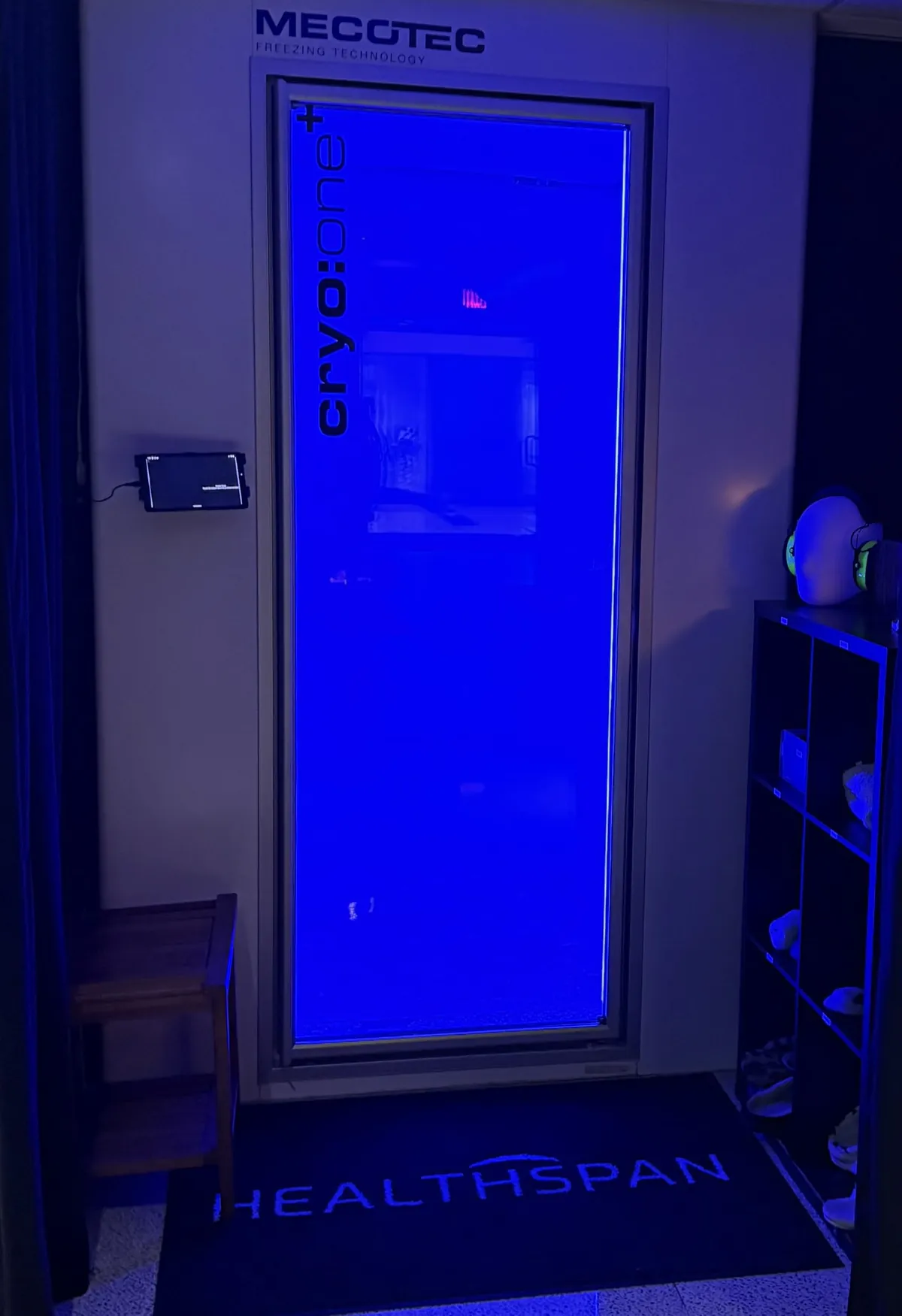
Three minutes in air colder than anywhere on Earth sounds extreme — and it is a little extreme, in the best way. Whole-body cryotherapy has become one of the signature services in modern recovery, and at Healthspan it's a favorite finisher. Here's what it is, how our nitrogen-free chamber differs from what you may have seen elsewhere, and what actually happens in those three minutes.
What Whole-Body Cryotherapy Is
Whole-body cryotherapy exposes your body to extremely cold air for a very short time — usually two to five minutes — in a specialized chamber. The goal is a brief, intense cold stimulus to the skin and surface tissues. Unlike a cold plunge, you stay dry, and the cold is delivered by chilled air rather than water, which makes it feel different: sharp and enveloping, but not wet.
From Rheumatology Clinic to Recovery Studio
Cryotherapy's origins are medical. In 1978, a Japanese rheumatologist named Dr. Toshima Yamauchi began experimenting with brief, extreme cold on the skin of patients with rheumatoid arthritis, looking for a way to ease their joint pain. He found that rapid surface cooling worked better than gradual cooling. European researchers, especially in Germany and Poland, spent the following decades refining the technique for inflammatory and rheumatic conditions. Only more recently did it cross over into athletic recovery and wellness.
Nitrogen-Free: Why Our Chamber Is Different
This is worth understanding, because not all cryotherapy is built the same. Many cryo studios use chambers cooled by liquid nitrogen, where you stand in a partial enclosure and nitrogen vapor surrounds your body. Healthspan uses a Mecotec Cryo:One+ — a fully electric, air-cooled, nitrogen-free chamber. Instead of nitrogen gas, it circulates extremely cold, dry air, and it's a walk-in chamber designed primarily for one person and able to accommodate two guests comfortably for a shared session.
The practical differences: there's no nitrogen gas to breathe, the whole body (including your head) is in the same controlled environment, and the experience is a dry, even cold rather than a vapor. Our chamber reaches around -124°F (-87°C). It's a design choice we made deliberately, and it's one of the things regulars mention most.
What the Research Shows
Emerging: recovery and soreness
A 2026 network meta-analysis of dozens of trials found whole-body cryotherapy performed well for delayed recovery markers after exercise, including reductions in muscle-damage markers and improvements in jump performance. Cold water immersion tended to edge it out for early pain relief, but cryotherapy held its own — this is a genuinely active area of research.
Emerging: mood
A 2020 randomized controlled trial found that a course of cryotherapy sessions, added to standard care, was associated with improvements in mood measures. It's an early but interesting finding.
Being straight with you
It's worth noting the FDA has said the evidence base for many marketed cryotherapy benefits is still limited, and no cryotherapy device is FDA-cleared to treat a medical condition. We use cryotherapy as a wellness service — a brief, invigorating cold stimulus that many members love — not as a treatment. The honesty is the point.
What to Expect at Healthspan
You'll change into minimal clothing and we'll give you what you need to protect your extremities: ear protection, gloves, and socks. Then you step into the chamber for two to five minutes — most first-timers start on the shorter end. To make the time fly, the chamber has headphones that sync to your phone, so you can pick the soundtrack for your session.
The cold is intense but dry, and because it's so short, it's very manageable. You can talk, move, and step out whenever you want. Members typically do cryotherapy three to five times per week. One practical tip: if you've just done a heavy strength workout and muscle growth is your goal, it's smart to wait a couple of hours before getting cold, for the same reason we mention with the cold plunge.
Cryotherapy in a Stack
Cryotherapy is a classic finisher because it leaves you sharp and energized. A popular Healthspan sequence is PEMF, then red light therapy, then cryotherapy — prime, support, finish cold. It's also used as a contrast partner with the infrared sauna. Our stacking guide walks through how to sequence it.
Who Should Be Cautious
Brief extreme cold puts a short demand on your circulation, so cryotherapy isn't for everyone. If you have a heart condition, uncontrolled high blood pressure, Raynaud's or cold sensitivity, or are pregnant, check with your healthcare provider first. Our staff supervises every session, and you're never in the chamber unattended.
Frequently Asked Questions
Is cryotherapy the same as a cold plunge?
Does your chamber use nitrogen?
How cold does it get and how long is a session?
Will I be freezing afterward?
How often can I do cryotherapy?
Try Cryotherapy in Brickell, Miami
Three minutes, dry, nitrogen-free, and genuinely invigorating — cryotherapy is one of the most talked-about services at Healthspan for a reason. Come try it at 1441 Brickell Avenue, Suite 310, Miami, and let our team walk you through your first session.