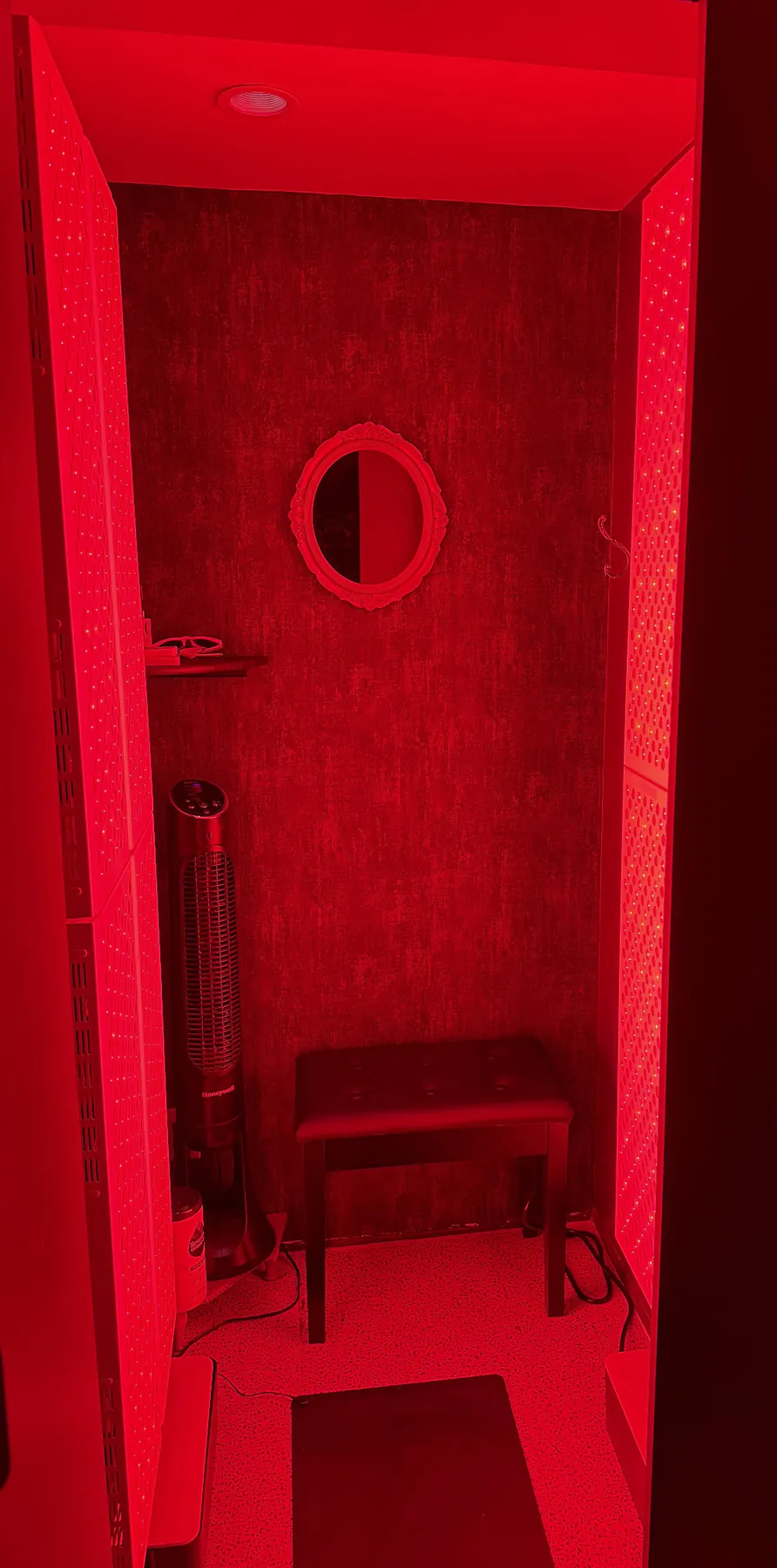
Red light therapy is one of those services that sounds futuristic and turns out to be simple: you stand in front of bright red and near-infrared light for about ten minutes, and that's the whole session. It's painless, effortless, and backed by a genuinely interesting body of science. Here's how it works and what it can — and can't — do.
What Red Light Therapy Is
Red light therapy, known more technically as photobiomodulation, uses specific wavelengths of red and near-infrared light delivered to the body. "Near-infrared" light sits just beyond what your eyes can see and penetrates a bit deeper into tissue; visible red light works closer to the surface. There's no heat to speak of and no ultraviolet — this isn't a tanning bed, and it won't burn or tan your skin. You simply stand in the light.
From a Nobel Prize to the Space Shuttle
Light as therapy has a distinguished history. In 1903, the Danish physician Niels Ryberg Finsen won the Nobel Prize for pioneering the use of concentrated light to treat a skin condition — an early proof that light could have real biological effects. The modern story picks up with NASA: in the 1980s and 90s, researchers used red LEDs to grow plants in space, then noticed the light seemed to help human tissue too, which sparked a wave of wound-healing research. What was once a space experiment is now a booth you can stand in on Brickell Avenue in Miami.
How Photobiomodulation Works
The leading explanation centers on your mitochondria — the tiny power plants inside your cells. A component of the mitochondria called cytochrome c oxidase appears to absorb red and near-infrared light, which can nudge the cell to produce energy (ATP) a little more efficiently. More available cellular energy is the proposed basis for the downstream effects researchers study, from skin changes to muscle recovery. There's also a "more isn't better" wrinkle: the effect follows a dose-response curve, so the right amount of light for the right time matters — which is why session length and equipment are designed, not guessed.
What the Research Shows
Established-leaning: skin and collagen
Some of the strongest evidence is in skin. A controlled 2014 trial found that red and near-infrared light improved skin complexion and increased collagen density compared with an untreated group. This is one of red light's better-supported uses.
Emerging but promising: muscle recovery and performance
Photobiomodulation has a relatively robust body of research for exercise. Reviews led by researchers like Leal-Junior have found that light delivered at the right dose, around the time of exercise, may support performance and post-exercise recovery. It's still an emerging field, but the quality of evidence here is better than for many recovery trends.
Early-stage: sleep and general wellbeing
You'll see red light marketed for all kinds of things. Some, like sleep and circadian effects, are genuinely early-stage — plausible, lightly studied, not established. We'll always separate the well-supported uses from the hopeful ones.
What to Expect at Healthspan
Our red light setup is built for full-body coverage and efficiency. We use standing booths, each fitted with eight BioMax 900 panels that deliver a spectrum of red and near-infrared wavelengths from the front and back at once. Because of that coverage, a session is just ten minutes — you stand, the light does its thing, and you're done.
A little prep helps: come with clean skin, and skip makeup, heavy SPF, or skincare products right before, since they can sit between the light and your skin. You can wear underwear or workout clothes, or use the private station for full coverage. There's no heat and no UV, so it's an easy session. Most members use red light three to five times per week — it's one of the easiest habits to keep.
A note on your eyes
We provide eye covers and recommend using them during your session. Our booths emit near-infrared light in addition to visible red, and because near-infrared is invisible, your eyes don't get the natural cue to look away from it. You'll sometimes hear people talk about red light and eye health — that research is genuinely early and not a reason to look into the panels, so our simple guidance is to wear the covers we provide and, if you have any eye condition, check with your eye doctor first.
Red Light in a Stack
Red light is one of our most "stackable" services because it's neutral — no heat, no cold, no exertion — so it slots in almost anywhere. Favorite Healthspan sequences include PEMF with red light (a quick two-step), PEMF with red light and cryotherapy, PEMF with red light and compression, and PEMF with hyperbaric oxygen therapy and red light. Our stacking guide shows how to combine it.
Who Should Be Cautious
Red light therapy is very well tolerated, but a couple of cautions apply. Use the eye covers we provide rather than looking into the panels. And if you take a medication that increases light sensitivity — certain acne medications, some antibiotics, and others — or use strong photosensitizing skincare like retinoids or acids, check with your healthcare provider or pharmacist first. If you're pregnant or managing a skin condition, a quick word with your provider is always sensible.
Frequently Asked Questions
Is red light therapy the same as a tanning bed?
How long is a session?
Does it hurt or feel hot?
What about my eyes?
What should I do to prepare?
How often should I use it?
Try Red Light Therapy in Brickell, Miami
Ten minutes, no heat, no effort — red light is one of the simplest habits to add to a recovery routine. Come stand in the light at Healthspan, 1441 Brickell Avenue, Suite 310, Miami, and see why it's a member favorite.