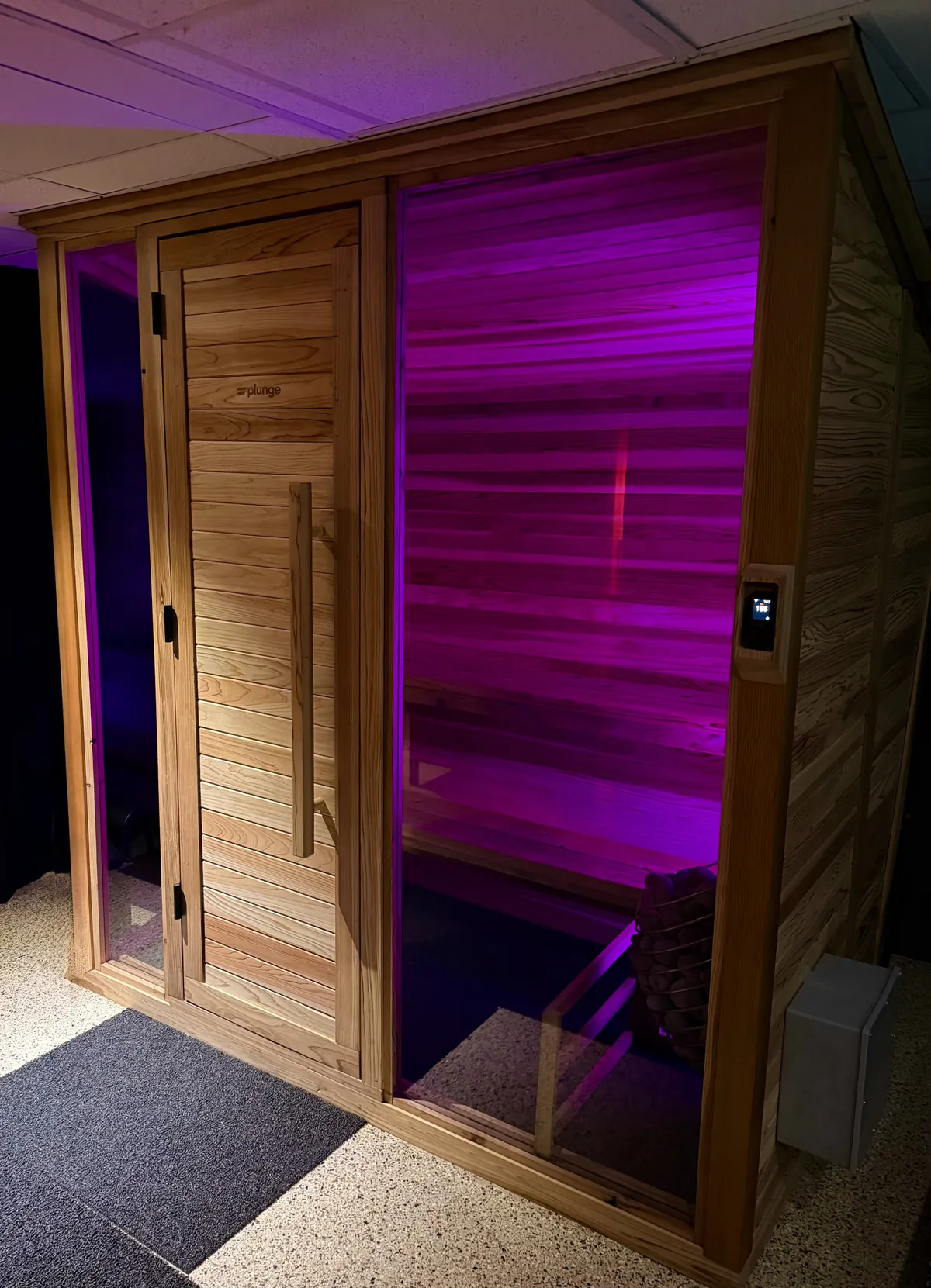
There's a reason the sauna has survived for thousands of years while wellness fads come and go: sitting in deep, dry heat feels wonderful, and the ritual around it is genuinely good for the soul. Our traditional sauna anchors the Nordic Area at Healthspan, and it's the heart of the contrast experience. Here's what a traditional sauna does, what the research suggests, and how to make the most of it.
What a Traditional Sauna Is
A traditional sauna — sometimes called a Finnish sauna — heats the air in the room to a high temperature, typically around 200°F, so that the hot, dry air warms your body and draws out a full, cleansing sweat. It's an intense, enveloping dry heat, quite different from the gentler warmth of an infrared cabin. You sit, you sweat, you relax, and — in the classic ritual — you cool off afterward, often with cold water. Our traditional sauna is a shared, group space that comfortably seats up to three people, which gives it a social, communal feel — very much in the spirit of the club.
A Two-Thousand-Year-Old Tradition
The sauna is one of humanity's oldest wellness practices. In Finland, sauna culture is believed to stretch back thousands of years and remains so central to daily life that there are said to be more saunas than cars; UNESCO recognized Finnish sauna culture as part of the world's intangible cultural heritage in 2020. The Romans, too, built elaborate heated rooms — the caldarium, warmed by furnaces beneath the floor — as the centerpiece of their bath houses. Across cultures and centuries, humans have kept returning to the same simple idea: heat, sweat, and community.
What the Research Suggests
An unusually deep evidence base
Traditional sauna has something most wellness services don't: long-running studies on large populations. A series of well-known Finnish studies, following thousands of middle-aged men over two decades, found that people who used a sauna frequently tended to have lower rates of cardiovascular problems and better longevity outcomes than those who used it rarely.
An honest caveat about those studies
It's important to read those findings correctly. They are observational — they show an association between frequent sauna use and better health, not proof that the sauna caused it. The people who sauna often may differ in other ways. Researchers have proposed plausible mechanisms (the way heat gently stresses the cardiovascular system resembles light exercise), and the findings are encouraging, but they aren't the same as a controlled trial. We'd rather you understand the nuance than oversell the headline.
Recovery and relaxation
For our members, the most tangible benefit is simpler: a sauna is deeply relaxing, and post-sauna cool-down is associated with a shift toward the body's "rest and recover" state. Even here the evidence is mixed, but the lived experience is hard to argue with — few things unwind you like good heat.
A great finish to a workout — including strength days
The sauna is an especially good way to end a workout. Unlike a cold plunge, which can blunt some muscle-building adaptations right after lifting, post-exercise heat doesn't appear to work against strength gains — a 2025 controlled study of post-exercise sauna found it didn't impair muscle growth, and heat is being actively studied as a way to support recovery and adaptation. It's still an emerging area, but it makes the sauna a smart choice after a hard session, particularly strength work, when you'd want to avoid immediate cold.
A deep, dry-heat sweat
A traditional sauna is dry heat, and it produces a serious sweat — which is part of why members reach for it as a way to support the body's natural processes and "detox." A few small, preliminary studies have detected trace metals and some environmental compounds in sweat, so it's a popular way to describe the experience; we'd just gently note that the science here is early and sweating is one modest route among several the body uses. Enjoy the deep sweat for what it reliably is: cleansing and satisfying.
Easier breathing
Many members mention that their breathing feels clearer and easier after a dry-heat session. The research is modest — long-term studies link regular sauna use to lower rates of respiratory issues, and older physiology work noted short-term changes in breathing — but that open, easy-breath feeling afterward is something regulars describe often.
The Nordic Area: Where Heat Meets Cold
At Healthspan, the traditional sauna sits in our Nordic Area — a semi-private, coed wet space with direct access to a rinse shower and our cold plunges. That's no accident. The traditional sauna is the natural starting point for contrast therapy: heat up in the sauna, then finish in the cold plunge. It's the same ritual the Finns have practiced with lakeside saunas for generations, brought indoors to Brickell, Miami. If contrast is what you're after, this is where it happens — and we've written a full article on how to do it.
What to Expect
Members average about 15 to 20 minutes in the traditional sauna, though it's very personal — listen to your body and step out whenever you like. Hydrate well before and after, since a high-heat sauna produces significant sweat. Many members follow the sauna with a cool rinse or a cold plunge to finish — heat first, then cold, the classic pairing. Bring a towel, take it at your own pace, and enjoy the fact that for a while there's nothing to do but sit and sweat.
Traditional Sauna in a Stack
The traditional sauna is the backbone of our warm and contrast stacks. Classic Healthspan sequences include PEMF, then traditional sauna, then cold plunge — the definitive contrast stack — and PEMF with traditional sauna and red light for a warmer, gentler finish. Our stacking guide shows how to build around it.
Who Should Be Cautious
High heat asks something of your cardiovascular system, so use good judgment. If you're pregnant, have a heart condition, high or low blood pressure, or another medical condition, check with your healthcare provider before using a high-heat sauna. Never use the sauna after alcohol, always hydrate, and leave if you feel lightheaded. Ease into the cold plunge afterward rather than shocking your system.
Frequently Asked Questions
How hot is the traditional sauna?
How long should I stay in?
Is the traditional sauna private or shared?
What's the Nordic Area?
Traditional or infrared — which is better?
Do the Finnish sauna studies prove it makes you healthier?
Experience the Nordic Ritual in Brickell, Miami
Deep heat, a cold plunge steps away, and a space built for the ritual — the Nordic Area is Healthspan at its most timeless. Come warm up, finish cold, and see why it endures. We're at 1441 Brickell Avenue, Suite 310, Miami.