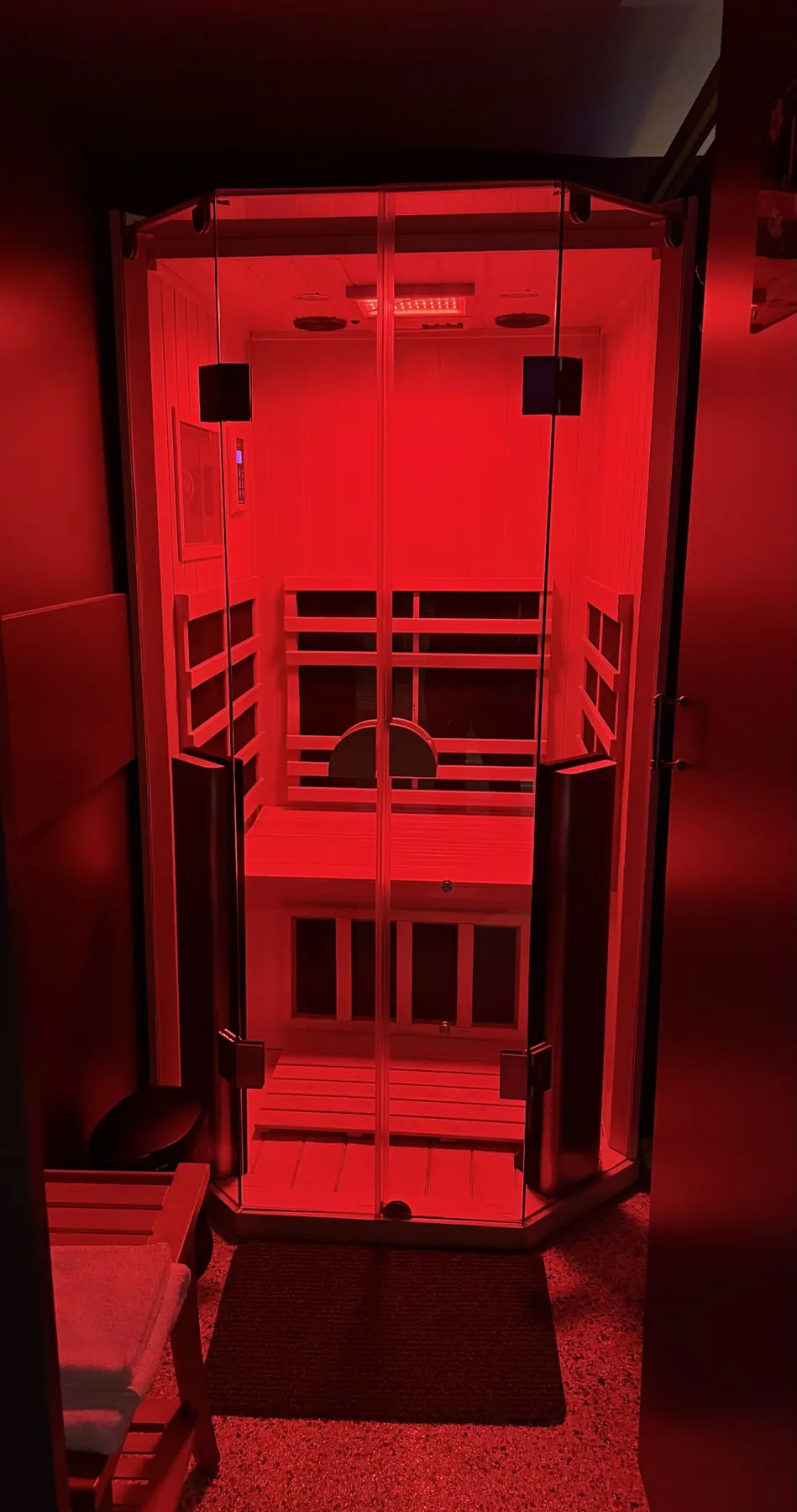
If a traditional sauna feels like stepping into a hot oven, an infrared sauna feels more like standing in warm sunshine. It's a gentler, lower-temperature heat that many people find easier to sit with — and it's become one of the most approachable ways to add heat therapy to a routine. Here's how full-spectrum infrared works, how it differs from a classic sauna, and what to expect at Healthspan.
What Makes Infrared Different
A traditional sauna heats the air around you, and the hot air heats your body. An infrared sauna skips a step: it uses infrared light to warm your body directly, while the air stays much cooler. That's why an infrared cabin runs at roughly 110–140°F, versus around 200°F for a traditional sauna, yet still produces a deep, satisfying sweat. For anyone who finds a traditional sauna too intense, infrared is often the more comfortable entry point.
What "Full Spectrum" Means
Infrared light comes in three bands — near, mid, and far — and each penetrates the body a little differently. A full-spectrum infrared sauna, like the Clearlight cabins we use, delivers all three at once rather than just one. In broad terms, the manufacturer associates near-infrared with skin and surface tissue, mid-infrared with warmth and circulation, and far-infrared with a deep, comfortable heat. "Full spectrum" simply means you're getting the complete range rather than a single band.
A Newer Take on an Ancient Practice
Heat bathing is thousands of years old — the Finns and the Romans built entire cultures around it. Infrared is the modern chapter. The technology traces back to Japan in the mid-1960s, when a doctor patented a ceramic far-infrared heater; it was reserved for medical use there for years before reaching the wider public and arriving in the U.S. around the early 1980s. Full-spectrum cabins that combine all three wavelengths came later still. So while the idea of therapeutic heat is ancient, the infrared sauna itself is a relatively recent invention.
What the Research Shows
Being upfront: thinner evidence than traditional sauna
It's worth saying plainly that the research base for infrared saunas is smaller and less mature than for traditional Finnish saunas, which have decades of large studies behind them. Most infrared studies are small, and the strongest review of the field concluded the evidence for many claims is limited.
Where there's some support
That same body of work found the most support around relaxation and blood-pressure measures, with weaker or preliminary evidence elsewhere. An infrared sauna does produce a deep sweat, which is why many members fold it into a cleansing, "detox" routine — just know that the evidence sweating removes a meaningful amount of anything is preliminary, and claims about weight loss or cholesterol are the least supported of all. We mention this not to talk you out of it, but because you should know what's solid and what isn't. The reliable appeal of an infrared sauna is simple: it's a deeply relaxing, comfortable, private way to warm up and sweat.
What to Expect at Healthspan
We have two Clearlight full-spectrum infrared saunas, and each is a private, single-person cabin — so you have complete privacy for your session, which many members love. You can go in lightly dressed or, in the privacy of the cabin, enjoy a fully unclothed session if you prefer. Bring a towel.
One thing that surprises first-timers: because the air is cooler than a traditional sauna, you may not feel much heat at first. Don't let that fool you — the infrared is working, and a deep sweat builds over the session. Hydrate well before and after. Sessions typically run 15 to 45 minutes depending on your goals and comfort; start on the shorter side and see how you feel.
Infrared vs. Traditional: Which Should You Choose?
There's no wrong answer — it comes down to preference. Choose infrared if you want a gentler, lower-temperature heat, a private cabin, and a longer, more meditative sweat. Choose traditional if you love intense, enveloping heat and the social, communal sauna experience (and the option to pair it with a cold plunge for contrast therapy). Plenty of members use both, depending on their mood and their goal that day.
Infrared in a Stack
Infrared sauna is a relaxing anchor for a warm stack. A favorite Healthspan sequence is PEMF, then infrared sauna, then red light — prime, warm, and finish gently. For those who like contrast, PEMF with infrared sauna and cryotherapy alternates deep heat with sharp cold. Our stacking guide covers the options.
Who Should Be Cautious
Heat puts a mild demand on your body, so a few cautions apply. If you're pregnant, have a heart condition or blood-pressure concerns, or are managing any medical condition, check with your healthcare provider before using a sauna. Never use a sauna after drinking alcohol, hydrate well, and step out if you feel dizzy or unwell. Cool down gradually afterward.
Frequently Asked Questions
What's the difference between infrared and a regular sauna?
Does "full spectrum" matter?
Why don't I feel very hot in an infrared sauna?
Is the infrared sauna private?
How long should a session be?
Try the Infrared Sauna in Brickell, Miami
If intense heat has never been your thing, the infrared sauna might change your mind — gentle, private, and deeply relaxing. Book a session at Healthspan, 1441 Brickell Avenue, Suite 310, Miami, and find your temperature.