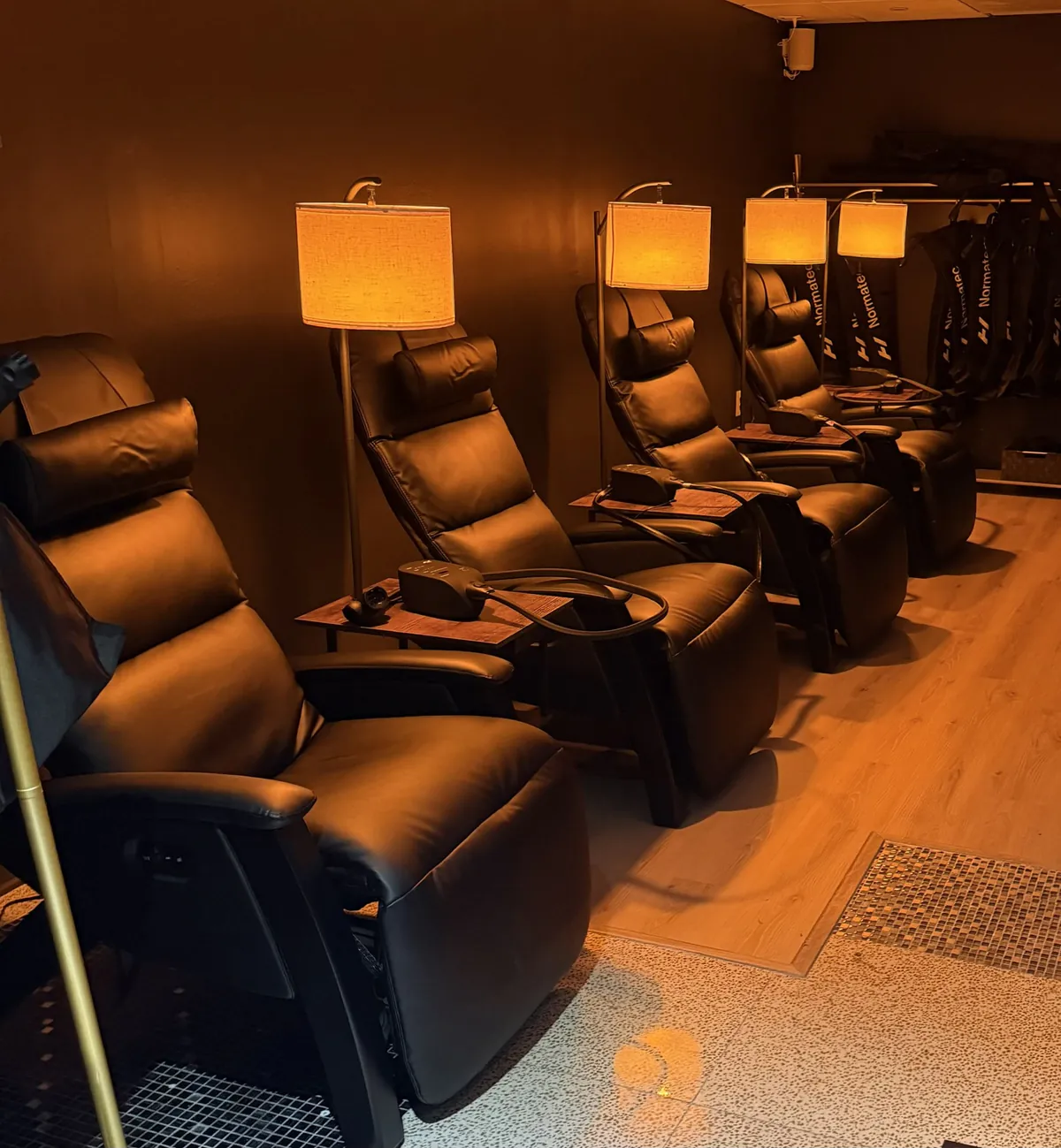
Some recovery services ask a lot of you — the shock of cold, the intensity of heat. Compression therapy asks nothing. You sit back in a recliner, slip into a pair of boots, and let them massage your legs while you relax for half an hour. It might be the most effortless service at Healthspan, and it's a rest-day favorite. Here's how it works and what it's good for.
What Pneumatic Compression Is
Pneumatic compression therapy uses inflatable sleeves — most often boots that wrap your legs, though they also come for arms and hips — connected to a pump. The pump inflates and deflates chambers within the sleeve in a rhythmic, wave-like pattern, gently squeezing your limbs and releasing. The sensation is like a firm, methodical massage that travels up the limb. It's designed to support the natural movement of blood and fluid back toward the heart.
Born in the Clinic, Adopted by Athletes
Compression therapy has a genuinely touching origin story. Normatec, the brand we use, was created by Dr. Laura Jacobs, a physician and bioengineer who originally developed the technology to help patients dealing with swelling — lymphedema — often after cancer treatment. It began as a medical tool for circulation and fluid management. Her son later saw its potential for athletes, and the pulsing-massage technology made its way into locker rooms, training rooms, and eventually recovery studios. Hyperice, which now makes Normatec, brought it to the mainstream. That clinical heritage is part of why the pulsing patterns feel so precise.
How It Works
The boots use preset, patterned pulses rather than simply squeezing all at once. Chambers inflate in sequence, working from the far end of the limb upward — a bit like how your body's own circulation moves fluid back toward the core. The rhythmic squeeze-and-release is thought to encourage circulation and help move the fluid and metabolic byproducts that accumulate in tired limbs, which is why so many people describe their legs feeling lighter and less "heavy" afterward.
What the Research Shows
Reasonably supported: how you feel
The most consistent finding across studies is that pneumatic compression improves how recovered you feel — it delivers real, if temporary, relief from post-exercise soreness and heaviness. For a service this effortless, that's a meaningful benefit, and it's why athletes keep using it.
Where the evidence is thinner
Being straight about it: the evidence that compression measurably improves objective performance or changes recovery biomarkers over the following days is more limited and mixed. Reviews tend to find the subjective, immediate benefits are the strongest and most reliable part of the picture. So think of compression as a genuinely pleasant, likely-helpful recovery aid — not a performance transformer. Set that way, it rarely disappoints.
What to Expect at Healthspan
This is the easy one. You settle into a recliner, we fit the Normatec boots, and you choose your comfort level. Then the boots do the work in their rhythmic, wave-like pattern while you read, scroll, close your eyes, or chat. Sessions are 30 minutes. There's no heat, no cold, no exertion, and nothing to recover from afterward. Many members pair it with something else so their legs get worked while the rest of them relaxes.
Compression in a Stack
Because compression is completely passive, it's one of the best multitaskers in a stack. A favorite Healthspan sequence is PEMF, then red light therapy, then compression — a gentle, no-shock stack you can do any day, including right after a workout when you want to avoid cold. It's also a natural rest-day service on its own. Our stacking guide shows how to fit it in.
Who Should Be Cautious
Compression is very low-risk for most people, but there are real exceptions. Avoid it if you have a blood clot (deep vein thrombosis) or a history of them, an acute injury, fracture, wound, or infection in the area, or certain circulatory conditions where increasing blood and fluid return isn't advisable. If you take blood thinners or have any vascular condition, check with your healthcare provider first. When in doubt, ask us and ask your provider — it's a quick conversation.
Frequently Asked Questions
What does compression therapy feel like?
How long is a session?
Is it safe to do after a workout?
Will it actually improve my performance?
Who shouldn't use it?
Recover the Easy Way in Brickell, Miami
If you've been on your feet all day or just finished a hard session, thirty minutes in the compression boots is the most relaxing recovery you'll do all week. Find us at Healthspan, 1441 Brickell Avenue, Suite 310, Miami.