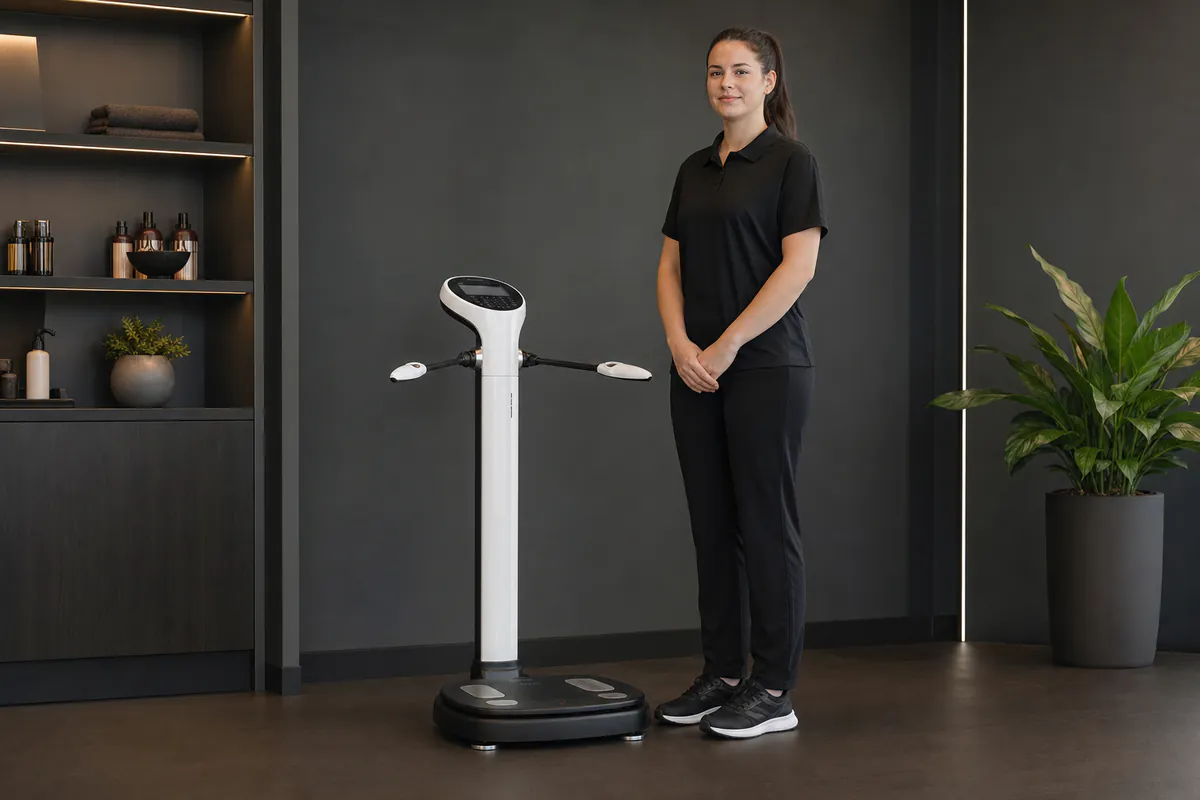
The bathroom scale has a fundamental flaw: it tells you how much you weigh, but nothing about what that weight is made of. Lose five pounds of fat and gain three of muscle, and the scale barely moves — even though your body has changed for the better. That's the gap an InBody scan fills. It's the measurement tool that makes the rest of your wellness routine legible, and it takes about 45 seconds. Here's how it works.
What an InBody Scan Is
An InBody is a body-composition analysis: instead of a single weight number, it breaks your body down into its major components — how much is muscle, how much is fat, and how much is water. You stand on the device, hold the handles, and in under a minute it produces a detailed readout. Think of it as the difference between knowing the total on a receipt and seeing the itemized list.
How It Works: The Science of BIA
The technology is called bioelectrical impedance analysis, or BIA. The device sends a very small, completely painless electrical current through your body and measures how easily it passes. This works because different tissues conduct electricity differently: muscle holds a lot of water and conducts well, while fat resists the current. By measuring that resistance, the device estimates your body composition.
What makes the InBody more sophisticated than a basic body-fat scale is how granular it is. The InBody 570 we use takes 15 separate measurements — three frequencies across each of five body segments (your arms, legs, and trunk) — so it can report not just your totals but a segment-by-segment breakdown. That's how it can tell you whether, say, one leg is carrying more muscle than the other.
A Korean Innovation
InBody comes from South Korea, where the company (originally called Biospace) was founded in 1996 by Dr. Kichul Cha. His aim was a more precise, segment-by-segment approach to body-composition measurement than the single-number tools of the time. The technology has since become a fixture in gyms, clinics, and research settings around the world — a quiet standard for tracking how bodies change.
What It Measures
A single scan gives you a rich snapshot, including your total muscle mass (specifically skeletal muscle mass), body-fat mass and percentage, total body water, and a visceral-fat assessment — visceral fat being the deeper fat around your organs that matters most for health. Because of the segmental analysis, you also see how muscle and fat are distributed across your body, not just the totals.
How Accurate Is It?
Here's the honest picture, because accuracy questions come up a lot. The gold standard for body composition is a DEXA scan, and studies show InBody devices are highly reliable and track closely with DEXA — but not identically. Research has found the InBody tends to read body fat slightly lower than DEXA does, with a small, consistent offset. What that means in practice is important: InBody is excellent for tracking your own change over time — the trend is what matters — and very good, though not perfect, for a single absolute number. The smartest way to use it is as a progress tracker, comparing your own scans month to month, rather than obsessing over one reading.
Getting a consistent reading
Because BIA measures body water, hydration affects your results. For meaningful comparisons, test under similar conditions each time — ideally a similar time of day, and not right after a workout, a big meal, or a lot of fluid. Consistency in how you test is what makes the trend trustworthy.
Why It's the Anchor of a Routine
An InBody scan is what turns a wellness routine from a feeling into a measurement. Are your recovery habits, training, and nutrition actually building muscle and reducing fat? The scale can't tell you. A periodic InBody can. That's why we treat it as the natural starting point and check-in for members: scan at the beginning to set a baseline, then re-scan every few weeks or months to see what's actually changing. It keeps everything else honest — including whether a given routine is working for you.
What to Expect at Healthspan
It couldn't be simpler. You step onto the InBody 570, hold the handles with your arms slightly away from your body, and stand still for about 45 seconds. The device is non-invasive and auto-calibrated — there's nothing to set up. You'll get a clear printout to keep and compare against future scans. Many members do a scan when they join to establish a baseline, then repeat it periodically to track progress. It pairs naturally with a conversation with our team about what your numbers mean and where to focus.
A Couple of Notes
BIA is a reliable, convenient estimate, not a laboratory measurement, and no body-composition tool is perfect. A very small note on safety: because the device passes a tiny electrical current, people with an implanted electronic device such as a pacemaker should skip it and let our team know. Otherwise, it's one of the easiest and most useful 45 seconds you can spend on your health.
Frequently Asked Questions
What does an InBody scan measure?
How long does it take?
Is it as accurate as a DEXA scan?
How do I get a consistent reading?
How often should I get scanned?
Get Your Baseline in Brickell, Miami
You can't manage what you don't measure. Start with an InBody scan at Healthspan, set your baseline, and let our team help you build a routine you can actually track. We're at 1441 Brickell Avenue, Suite 310, Miami.